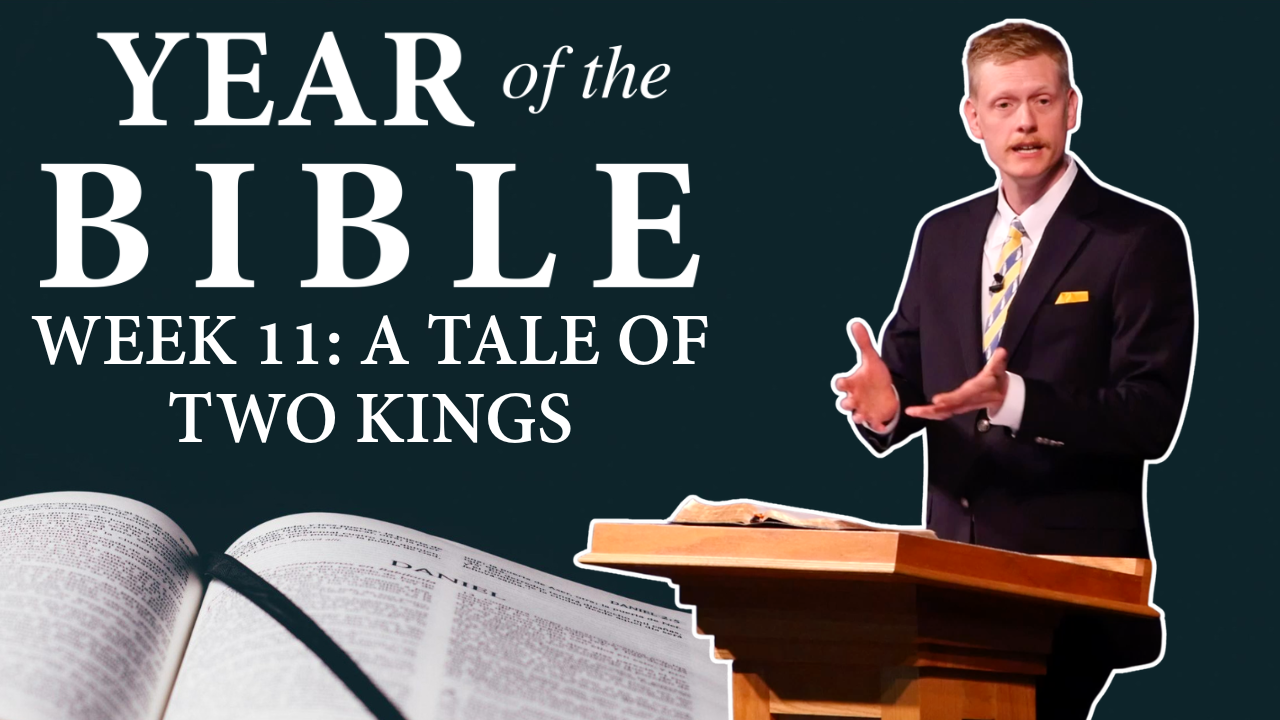
The True & Faithful King
Pastor Matt Bell
Sermon Summary
This sermon, Pastor Mark examines the life of King Saul in 1 Samuel 15, highlighting three critical failures that ultimately led to the kingdom being taken from him: disobeying God's explicit word, blaming others for his sin, and fearing man over God. Though Saul claimed he had performed God's commandments, his partial obedience in sparing the Amalekite king and the best of the livestock was exposed as outright disobedience. By contrasting Saul's compromises and excuses with the perfect, sacrificial obedience of Jesus Christ—the true and better King who willingly took responsibility for our sin and submitted entirely to the Father's will—the congregation is challenged to give God their absolute best, own their sin in true repentance, and cultivate a reverent fear of the Lord rather than seeking the approval of men.
Sermon Transcript
And we are going to be continuing our journey, as we're calling 2026, the year of the Bible, continuing to go through God's Word. And so if you could open with me this morning to 1st Samuel chapter 15. We'll be looking at 1st Samuel 15 this morning, but before we begin, I'd like to pray.
Father, we thank you for another day to live for you, and another Lord's day, God, to be in your house. Lifting you up, magnifying you, the one true king. Lord, I pray that you would bless this time of your word going forth, Lord, that you would prepare hearts to hear from you today. We thank you for this, in Jesus' name. Amen.
The Year of the Bible
So if you're new to our church here today, we're calling 2026 the year of the Bible. And we've created a Bible reading plan for all of our church people to be reading through the Bible every day with the endeavor to read through the entire Bible this year. And so each Sunday we're taking a selected passage from that week's reading and preaching through it. I want to encourage you if you've been going along with us in this reading plan, and maybe you fell behind a little bit, not to give up. We print the following week's reading in the bulletin. So if you have your bulletin today, maybe you fell behind a little bit. Maybe you lost the Bible reading plan. You don't even know where it is. Instead of giving up, you can just pick up where we are continuing today. So you can look in there. And if you're new to the church, and this is the first year hearing of it, I want to encourage you. You can follow along as well. You can go to our website and pick up one of those Bible reading plans.
Israel Rejects God as King
This morning, we're going to be looking at King Saul. This week in our reading, we read all about King Saul. The reason there is a king is because the Israelites rejected God as their king. When God delivered the people out of Egypt, he brought them into the promised land, he gave them his law. He showed them how it was to live. God was their king. God ruled over the people of Israel through his law. Yes, there were judges who helped to apply God's law. There were the priests who taught God's law and showed how to worship. But God was their king. And a king's job is to establish law and uphold justice. And so Israel didn't need a king because God was their king and God had given them his perfect law.
But as you read this week, Israel rejected that law. They rejected God as king. And in 1st Samuel chapter 8, verse 5, Israel comes and they say to Samuel, the prophet, we want a king like the other nations. They had rejected the system of the judges. They said, we no longer want judges. We no longer want to be ruled by God's law. We want a king to rule over us like all the other nations. All the other nations at the time were pagan nations. So really what the Israelites were asking for was a pagan king. And so God gave them what they wanted. What we see in the life of King Saul is that he indeed was a king just like the other nations. And so we're going to look at this pivotal point in Saul's life today in 1st Samuel 15.
This morning, we're going to look at three failures of Saul that ultimately led to the kingdom being taken from him. Three failures, and then we're also going to look at Christ. Christ, the true and better king, and we're going to see how where Saul failed, Christ obeyed. As we look to Christ's example, we too can be obedient in our lives as well.
The Command to Destroy Amalek
So if you have your Bibles, hopefully that was enough time for you to find where 1st Samuel 15 is. Let's go ahead. I'm going to read verses 1 through 3. We're going to work our way through this whole chapter today. I'm not going to read the whole chapter up front. We'll look at a few portions and then talk through it and continue in that pattern. So 1st Samuel 15, verses 1 through 3, it says:
And Samuel said to the Lord, "The Lord sent me to anoint you"—he's talking to Saul—"king over his people Israel. Now, therefore, listen to the words of the Lord. Thus says the Lord of hosts, 'I have noted what Amalek did to Israel in opposing them on the way when they came up out of Egypt. Now go and strike Amalek and devote to destruction all that they have.'"
So here God commands Saul and his army to go and completely wipe out, annihilate, take out the Amalekites. And this might be hard for some of us to read because it goes on to say, leave no one, no survivors. Man, woman, child, infant, that all were to be what God says "devoted to destruction."
Now, it's important to know the context behind this. God says the Amalekites have opposed Israel, that they opposed the Israelites as they came up out of Egypt. We see this in Exodus chapter 17. If you've been reading through the Bible, maybe you remember that account where Israel went to fight the Amalekites, and Moses had to keep his arms in the air. As long as his hands were raised, Israel was victorious over Amalek, but if his hands began to fall, they would lose in the battle. So Aaron and another man came and held up Moses' hands, and as long as his hands were up, they were victorious. And so Israel was indeed victorious over Amalek on that day.
But what led to this was an unprovoked battle. Israel wasn't looking to go to war with Amalek. What happened was Amalek and the Amalekites actually came to the back of Israel's camp while they were traveling, and they started attacking the elderly and the children as they would be the ones in the back of the camp. If you've ever been on a hike with someone before or tried to hike with your little kids, they slow you down a little bit, right? You want to go at one pace, but they want to go at another. Multiply that by a million plus traveling through the wilderness. It was the elderly and the children who were behind in the pack, and the Amalekites came and started killing these elderly and children. And so this started this battle. Ever since then, up into this point, the Amalekites have been a thorn in the side of the Israelites.
And so God had decided here in this account, coming to King Saul, that now was the time that he was going to blot out the Amalekites. We see that God promised Moses that this would happen in Exodus 17:14. God says to Moses, after they had won the battle:
"Write this as a memorial in the book and recite it in the ears of Joshua, that I will utterly blot out the memory of Amalek from under heaven."
So God comes and gives a word to Saul, essentially saying, today is the day that I have decided to uphold my word, that the Amalekites are going to be no more. And I want you to understand, this wasn't a battle of conquest like they had done taking the promised land, where they were to take that land and hold onto that land, and they could keep some of the spoil. This was a battle of judgment. God was using the Israelites as his hand of final judgment on the Amalekites because of what they had done previously to Israel.
And if you see here where God says to destroy them, devote them all to destruction. The Hebrew term for this phrase "devote to destruction" is spelled H-E-R-E-M. It's pronounced herem. And what it communicates is to set something apart that belonged to God. So what God was coming and saying to the Israelites is, the Amalekites are to be no more; you are to give them all to me. Their time has come. Save none of them, save none of their flocks, save none of their possessions. All of it is to be destroyed. All of it is to be offered up to me.
And so Saul gathers 210,000 soldiers and they go and they defeat the Amalekites. And if that's all Saul did, if he obeyed God perfectly, this would be a very short chapter and a very short sermon. Maybe some of you are in here thinking, man, I wish Saul really would have obeyed. Because it's already getting late and I'm hungry. But that's not what happened.
Failure 1: Disobeying God's Word
So, Saul did defeat the Amalekites, but then we come to verse 9. And here we see the first of Saul's failures. So today we're going to be looking at three of these failures. The first one is that he disobeyed God's word. Let's look at verse 9. It says:
But Saul and the people spared Agag—
Agag was the king of the Amalekites.
—and the best of the sheep and of the oxen and of the fattened calves and the lambs, and all that was good, and would not utterly destroy them. All that was despised and worthless, they devoted to destruction.
So, they wiped out most of the Amalekites, but they saved the king and they saved the best of the cattle. Verse 9 is really the turning point of Saul's life. And it begins with a "but." Now, there are some good "buts" in the Bible. Ephesians 2 is one of those really good ones where it lists who we are, we fall short, we're sinful, we deserve God's wrath, but then it says, "but God being rich in mercy." That's a really good "but" in the Bible. This is not one of those. It says, but Saul and the people spared Agag and all of the best of the flock.
They didn't just keep some of the flock; they made a decision. We're going to keep the best of the livestock, and we're going to give God the worst. We're going to devote the worst to destruction. We're going to herem—we're going to consecrate to the Lord—the leftovers.
Giving God Our Best
And we need to be careful that we are not living in this way, where we give everyone else our best and we give God our leftovers. There are a lot of applications we can think about for this, but I want to look at a couple.
One of them is in our giving, in our tithing. That we don't wait till the end of the month and see if we have anything left over, and then if we do, well, that's what we'll offer up to the Lord with our giving. No, we should give God our first and our best. In the Old Testament, this type of giving was called a first fruit offering. They wouldn't wait to see after their crops if they had any left to offer up to the Lord. They would give the very first of their harvest unto the Lord. In doing so, they were saying, God, I trust in you that you're going to provide for me the rest of this season, that you're going to be faithful to me. And the same should be true with our giving. When we give our best to the Lord, when we give our first, when we budget our giving and our monthly budgeting first, instead of waiting until the end, what we're saying is, God, I trust that you are going to provide for me. God, I know what your word says, and I'm going to stand on it, and I am going to be faithful in my giving. So we want to be sure that we are giving God our best in our lives.
How about coming to church for worship? Are we giving God our best? What does it look like to give God your best when you come to worship on Sunday morning? Well, first, it would be being here. So everybody that can hear me and see me right now, in person, congratulations. You've taken that step of giving God your best on the Lord's day. Another one would be being here before 10 o'clock. It's amazing to think about, but that's what time church starts. And if we're to give God our best, being on time for church would certainly fall in line with that. I could poke y'all a little bit more on that point, but I would like Pastor Matt to have a church to come back to next Sunday. So I'll continue on.
But this is something important to think about, not just in giving and coming to church, but in all areas of our lives. What would giving God my best in this situation look like right now? This morning we were singing this song of laying our crowns down and giving our lives as an offering. This is what it means to give your life as an offering, that you give your best to the Lord in every area of your life. And when we do that, we are being obedient to God. There are passages that back this up, but one of them is whatever you do, do it wholeheartedly, as unto the Lord, and not unto men, that we are to give our best to the Lord.
The Danger of Partial Obedience
Okay, so now back to Saul's disobedience. God could not have been more clear. Leave no survivors, not even the king, not even the prize-winning rams and cattle. All of them were to be devoted unto the Lord. But Saul failed this, and God was not pleased. And we see this in verse 10. Verse 10 says:
The word of the Lord came to Samuel: "I regret that I have made Saul king, for he has turned back from following me and has not performed my commandments." And Samuel was angry, and he cried to the Lord all night, and Samuel rose early to meet Saul in the morning. And it was told Samuel, "Saul came to Carmel, and behold, he set up a monument for himself, and turned and passed on and went down to Gilgal." And Samuel came to Saul, and Saul said to him, "Blessed be you to the Lord. I have performed the commandment of the Lord." And Samuel said, "What then is this bleeding of the sheep in my ears and the lowing of the oxen that I hear?"
This is one of my favorite passages in the Old Testament. Saul comes up. He has the audacity to come to Samuel and say, I have done exactly what the Lord has asked, all the while he's got this petting zoo just right over his shoulder. Samuel says, no, you haven't. You have not obeyed the Lord.
But here Saul thought that his partial obedience would be pleasing to God. He wiped out almost all of the Amalekites. He destroyed some of the livestock. Surely this was good enough. And if we're honest, we can be guilty of this too. We can put up an appearance of doing everything right. I have done what God asked. I've obeyed the big commandments. I haven't killed anybody. I haven't committed adultery. I'm not stealing anything. I have done what God had commanded. All the while, we've got these sheep and oxen just making all sorts of noise behind us in our lives. Let it not be this way.
Maybe there is something you're holding onto. Maybe there's some unforgiveness in your heart, maybe there's some jealousy, maybe you've seen that you're provoking your kids to anger. Maybe you've been looking at something that you know is not appropriate and you're saying, yeah, but that's just a little sheep. That's just a little cattle. I'm doing everything right in all of these other areas. Partial obedience is disobedience. And Saul had convinced himself that he had done the right thing. He says, I have performed the commandment of the Lord. But he was walking in disobedience.
Christ's Perfect Obedience
So now we've looked at man's king. We've looked at the king that the people wanted. Let's look at Christ's example for a minute. Everything that Christ did on this earth was in perfect submission and obedience to the Father. Jesus didn't come and just obey God up until the point that it was convenient for him and then say, you know what, that's enough. This is going to get uncomfortable if I have to continue obeying what you're asking me to do. No, where Saul's obedience was partial, Christ's obedience was total.
If Jesus had taken Saul's approach and only obeyed up until the point that it was convenient for him, none of us would be in here today. There would be no Christianity. There would be no gathering of the saints. There would be no Lord's Day to celebrate because there would be nothing to celebrate. But where Saul spared the life of the king and the livestock for his own benefit, where he spared the king's life, Jesus Christ gave up his own life for the benefit of us.
Let's look at Jesus' prayer on the night of his betrayal in Luke 22. Starting in verse 41, it says:
And he withdrew from them about a stone's throw and knelt down and prayed, saying, "Father, if you are willing, remove this cup from me. Nevertheless, not my will, but yours be done."
Where Saul said, not your will, God, but mine be done. Jesus said, not my will, but yours be done. Paul says this of Christ in Philippians 2:8:
And being found in human form, he humbled himself by becoming obedient to the point of death, even death on a cross.
So Jesus' obedience to God, it cost him his life. But he willingly went to the cross because of his love for us, but also because it was the will of the Father. It was what God was asking him to do. And God has now revealed himself to us through his law, through his word. We know what God is asking us to do as his children. And so there's a question that comes to us, are we going to live like Saul or are we going to live like King Jesus? Are we willing to obey the Father no matter what the cost, no matter how difficult, no matter how uncomfortable it might make things? And we can do this. We can be obedient as we look to Christ, the true and faithful king, the better king, as our example.
Failure 2: Blaming Others for Sin
Let's continue on here with verse 15. Saul then. So Samuel says, what is this that I hear? Notice the language here that Saul uses. Saul says:
"They have brought them from the Amalekites. For the people spared the best of the sheep and of the oxen, to sacrifice to the Lord your God. And the rest, we have devoted to destruction."
So when it was something bad, they're the ones that did it. But when it talks about devoting to destruction, notice he includes himself. We have devoted to destruction.
Then Samuel said to Saul, "Stop! I will tell you what the Lord said to me this night." And he said to him, "Speak." And Samuel said, "Though you are little in your own eyes, are you not the head of the tribes of Israel? The Lord anointed you king over Israel. And the Lord sent you on a mission and said, 'Go, devote to destruction the sinners, the Amalekites, and fight against them until they are consumed.' Why then did you not obey the voice of the Lord? Why did you pounce on the spoil and do what was evil in the sight of the Lord?"
And Saul said to Samuel, "I have obeyed the voice of the Lord. I have gone on the mission on which the Lord sent me. I have brought Agag the king of Amalek"—which he should have left that part out because he was just confessing his sin—"and I have devoted the Amalekites to destruction. But the people took of the spoil, sheep and oxen, the best of the things devoted to destruction, to sacrifice to the Lord your God in Gilgal."
So here we see Saul's second failure, and that he blamed others for his sin. When Saul was confronted with his sin, he did not accept responsibility. He didn't say, Samuel, you're right. I led poorly. I was supposed to be the leader of these people. I was supposed to be setting the example of what it looked like to obey God's word, and I failed. I have sinned, forgive me. He didn't do this. He dodged responsibility. He passed the blame onto everybody else.
But we must never have this attitude. We need to own our sin. When we are confronted with our sin, when we are convicted of our sin by the Holy Spirit, we don't say, well, if only you knew what was going on in my life. If only you knew how stressful work was today, it wasn't my fault that I yelled at my kids. It was my boss's fault for giving me that report five minutes before I was supposed to leave. Maybe you've had this attitude before. Or maybe you just blame Adam for everything. If Adam wouldn't have fallen in the garden, I wouldn't have this sin nature. So really it's his fault.
No, we need to own our sin. Stop making excuses for your sin. Stop trying to justify it. Take it for what it is. I believe it was R.C. Sproul that said all sin is cosmic treason against the God of the universe. There's no little sins, there's no minor sins. All sin is cosmic treason. Recognize what your sin is, own it. Repent of it, confess it. And guess what? When you do that, you will find healing. You will find forgiveness.
But when you just ignore that sin or you say, well, it wasn't my fault, it was their fault. What did that lady think wearing that dress? What was I supposed to do? Not look at her? All the ladies are wearing yoga pants at the gym. What do they expect? No, you can look away, everybody. You can look up. Gyms have TVs up there, look at the TV. Scripture says to take every thought captive, not blame every thought on everybody else. Take responsibility for your sin. King Saul was called to lead his people, and he failed in his calling. Many of us are called as heads of households to lead our families. Let's not fail in this calling because we're dodging responsibility, and we're blaming everybody else for what is our problem, what is our sin.
Taking Responsibility Like Christ
So let's look to Jesus. Now you might be thinking, well, Jesus never sinned. He never blamed anybody for his sin because he had no sin. But you see, on the cross, Jesus did take responsibility for sin. He took responsibility for your sin. On the cross, Jesus took the wrath of God that was due us for our sin, and he said, I'll take it. Put it on me. Nevertheless, God, not my will, but yours be done. I will take of the cup for their sin.
I don't have time to read it today, but if you would like to this week, read Isaiah 53 and look at all that Christ did for us. He was bruised, he was crushed. He took on our iniquity. He took responsibility for our sin. And so when we blame others for our sin, we are following King Saul. When we take responsibility for our sin, we are following King Jesus.
Failure 3: Fearing Man Over God
So now let's look at the conclusion of this passage today. Starting in the second half of verse 23. Samuel says:
"Because you have rejected the word of the Lord, he has also rejected you from being king." Saul said to Samuel, "I have sinned, for I have transgressed the commandment of the Lord and your words, because I feared the people and obeyed their voice. Now therefore, please pardon my sin and return with me that I may bow before the Lord." And Samuel said to Saul, "I will not return with you. For you have rejected the word of the Lord, and the Lord has rejected you from being king over Israel." As Samuel turned to go away, Saul seized the skirt of his robe, and it tore. And Samuel said to him, "The Lord has torn the kingdom of Israel from you this day and has given it to a neighbor of yours, who is better than you."
Notice here, Saul finally confesses his sin, but it isn't until after he finds out what the punishment for that sin is. I don't think he was truly repentant of this sin. I don't think he was grieved that his sin was harmful to his relationship with the Lord. I think his concern was saving face politically. Notice he says, Samuel, come back with me. Don't depart from me. Let's show the people that me and you are still in good standing. He was concerned about the optics.
But this isn't true repentance. Repentance isn't feeling bad for the consequences of your sin. Repentance is being moved in your heart, being grieved in your heart, recognizing what your sin is in light of who God is. So here Saul gives his motivation for why he did this at the end of verse 24 where he says, I feared the people and obeyed their voice.
The third point today, Saul's final failure was a fear of man over a fear of God. Saul feared men more than he feared the Lord. Saul cared more about what the people wanted than what God had commanded. And you see, fear of man will lead to compromise. When you care more about what man thinks of you and what their feelings are and trying to please men, that's going to lead to a life of compromise. Whereas fearing the Lord leads to a life of obedience.
So think of the times in your life when you've given in to peer pressure. This happened because you cared what people thought about you. You didn't want to disappoint people. You wanted to be a people pleaser. You wanted to go along with the crowd. You didn't want to let them down. And we've all been guilty of this before. And I think we are where we are as a nation because we've been living this out over multiple generations where people don't want to make others uncomfortable. We don't want people to think that we're hateful, or we don't want to have difficult conversations with people because that might make things odd or awkward.
So we're not going to speak out about abortion because we might be viewed as having anti-women's rights. Or I'm not going to challenge the family member that I know is living with his girlfriend and in a relationship that's not right, because that could make things difficult on Thanksgiving. And when we get to the table together, it's going to be really awkward. Listen, this is having a fear of man over God. And I think as we play this out over multiple generations, now this is what we see in the culture where the darkness is really taking over. It's because we haven't been willing to speak out and carry the light, because we have had a fear of man over a fear of God.
Now, of course, in all we do, when we talk to people, we do it in love. We share the truth of God's word. We don't have to be ugly with people. But if we do love those in our lives, we should be willing to speak up. Because of who God is. Because of what God has done for us. Galatians chapter 1, verse 10, Paul says this:
For am I now seeking the approval of man, or of God? Or am I trying to please man? If I were still trying to please man, I would not be a servant of Christ.
Listen, you can't have two masters. You can't be worried about serving man and also serving Christ. Man is always going to rise up to the top. We need to have that right fear of the Lord. God being holy, holy, holy, righteous and just and true. You see, eternity is at stake here. Your soul is at stake. The glory of God is at stake. So the question is, who will you serve? Are you going to serve man and their opinions, their preferences, or are you going to serve Christ and his kingdom and be obedient to his word?
Christ's Command to Fear God
Once more, let's look to Jesus as the better, true king, the better example. What does he say about this? Well, Jesus told his disciples in Matthew 10, he says:
"And do not fear those who kill the body but cannot kill the soul. Rather fear him who can destroy both soul and body in hell. Are not two sparrows sold for a penny? And not one of them will fall to the ground apart from your Father. But even the hairs of your head are all numbered. Fear not, therefore; you are of more value than many sparrows. So everyone who acknowledges me before men, I also will acknowledge before my Father who is in heaven, but whoever denies me before men, I also will deny before my Father who is in heaven."
Where are you denying Christ today? Where in your life are you choosing man over God because of your fear of men? Submit that to the Lord. Jesus had been telling his disciples right before this, look, you're going to be persecuted, you're going to be beaten, you're going to be flogged. But who cares? The worst thing they can do is usher you right into my presence. Have a right fear of the Lord. And we know the disciples took this to heart. They obeyed it, and countless others all throughout history have lived this out. They've been willing to sacrifice their lives, to stand for the truth of God's word, to defend the faith, no matter the cost. Because of that, the church is still standing today. And the church will continue to advance. God's kingdom will continue to advance as men and women stand up and say, men can do whatever they want to me. I follow Christ, I serve Christ. I'm going to speak the truth of Christ, whatever may come. Christ is my king. Amen.
And so do you have this fear for the Lord? This isn't a terror of the Lord, where if you sin, you're looking over your shoulder that God's going to strike you dead for your sin. No, it's a reverence for him. It's recognizing that he alone is holy, holy, holy. It's having a deep respect and admiration for who God is. Do you have this desire to please the only one who is worthy of praise?
Peter had this desire. Peter had a right fear of the Lord on the day of Pentecost. But what we see with Peter is also true for us. Peter in himself, in his own flesh, there's no way he would have been able to stand up in front of 3,000 Jews and say, you know what? It was actually you who crucified Christ and put him on the cross. Nobody could get up in their own power and do that. But he was given the Holy Spirit. And that same spirit that is in Paul, that same spirit that is in Peter, that same spirit that was in the disciples, that same spirit that was in Polycarp, that same spirit that was in Martin Luther, that same spirit that was in Leonard Coote, who founded this church 85 years ago in 1941, that same spirit is in you. And in the power of his spirit, you can stand up and say, I am going to follow Christ my king no matter what the world does to me.
Conclusion: Following the True King
And so maybe today you found yourself caring more and more about the opinion of man and less about pleasing the Lord. Look, repent. Don't make excuses. Don't say, well, you don't understand all the pressures at work. If I don't go to happy hour and have one or two or ten beers, everybody's going to think that I'm a bad person, or I don't care about socializing with your teammates. Look, who cares? If they think that, they think that, and if you get fired, you get fired, but your witness hasn't been harmed and Christ has been glorified. That needs to be our approach, not just at work, but in every area of our lives, and that is what it looks like to rightly be obedient. That's what it looks like to follow the one true king.
So this morning, we've seen two examples of kings. We've seen Saul and his three failures. He disobeyed the Lord. He blamed others for his sin, and he feared men over God. But also we've seen Christ's obedience. We've seen the one true, faithful king. We've seen that he obeyed God's word, he took responsibility for our sin, and then he feared God over man.
And so I pray that we'll all look to Christ's example. We'll all remember his example, but not just remember his example, but live it out and live it out every day of our lives in submission to our true king. Amen.