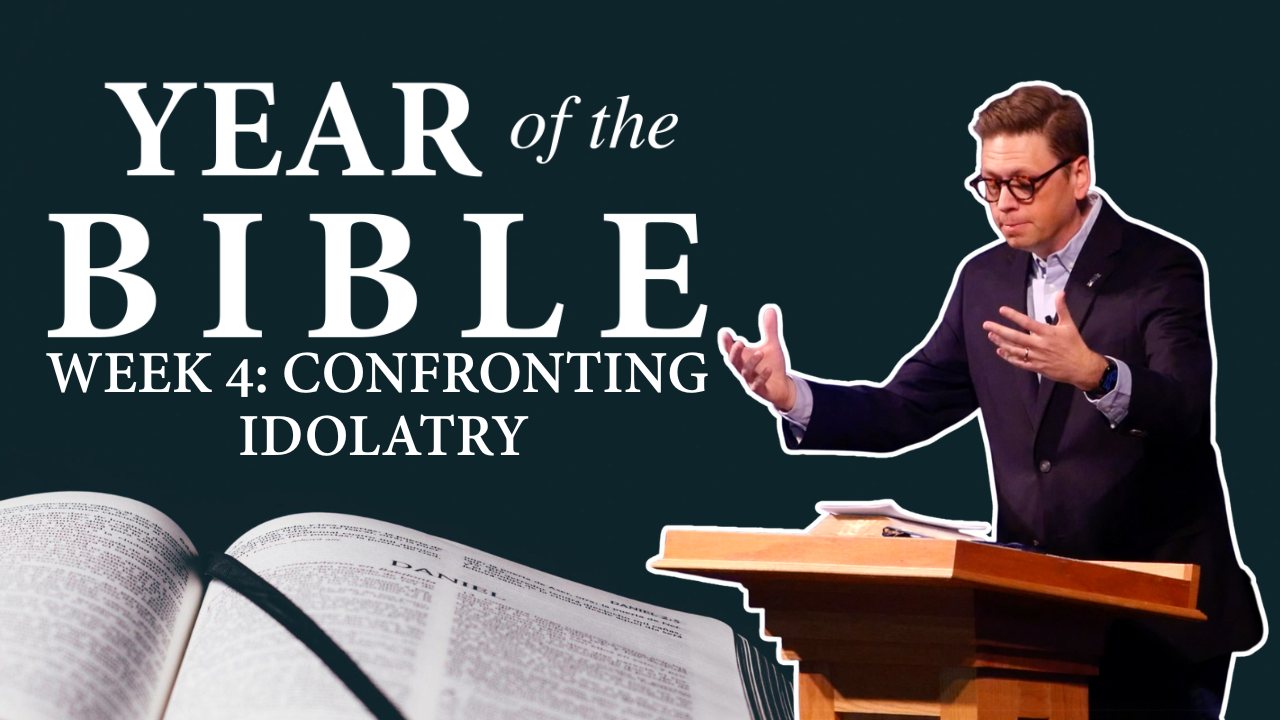
Confronting Idolatry
Pastor Matt Bell
Sermon Summary
In this exposition of Exodus 32, Pastor Matt addresses the catastrophic consequences of spiritual impatience and the human heart's default inclination toward idolatry. When Moses delays on Mount Sinai, the Israelites pressure a morally compromised Aaron into forging a golden calf, choosing a malleable, non-threatening false god over the holy, unapproachable, and convicting presence of the true God. The sermon contrasts Aaron’s failure to exercise his priestly authority to restrain evil with Moses's Christ-like intercession for a stiff-necked people, highlighting how believers today often create facsimiles of God that align with their own comforts rather than submitting to His holy standard. Ultimately, the narrative serves as a sobering call to fathers to exercise spiritual leadership in their homes, and for all believers to ruthlessly examine their hearts, reject flimsy excuses for sin, and ensure their ultimate affections are anchored in Christ alone.
Key Sermon Takeaways:
The Danger of Impatience: Spiritual catastrophe often follows when we refuse to wait on the Lord's timing and take matters into our own hands.
The Cost of Idolatry: The human heart is an idol factory; if the god you serve never convicts you of sin, you are serving an idol of your own making.
Priestly Leadership in the Home: Fathers and husbands possess a sacred trust and authority to shepherd their families, actively restraining evil and cultivating a love for Christ.
No Excuses for Sin: Blaming circumstances or other people for our sin—like Aaron blaming the fire for the golden calf—will not stand before the judgment seat of Christ.
The Superiority of Christ: Jesus is the true intercessor and the true source of living water; we must drink from Him rather than the contaminated streams of the world.
Sermon Transcript
Introduction and Biblical Context
If you have your Bibles open to Exodus 32, the book of Exodus chapter 32. I do want to apologize for the frog in my throat. I woke up this morning a little bit under the weather, but I've decided we're gonna persevere, so hopefully it doesn't sound as bad as it feels. That's my hope for you this morning. And the bad news is, I've got a frog in my throat. The good news is I sound like Barry White this morning, so we're gonna end this morning by singing, "Can't Get Enough of Your Love, Jesus." Okay? That's the goal.
But Exodus 32, if you have your Bibles, we're in a year-long series where, as a church, we're reading through the Bible together. We were calling it the Year of the Bible. We produced a Bible plan where you read three chapters on the weekdays and then five chapters on Sunday. When we get to wherever we're at in that reading that week, I'm picking a passage that we read and preaching from that passage each week.
Last week, we finished the book of Exodus and moved into the book of Leviticus, the third book of the Bible. This coming week, we'll finish Leviticus and move into the fourth book, the book of Numbers. I wanted to let you know that with every new book that we enter into, I'm making some overview videos of each book of the Bible, sharing some information that I think would be beneficial to you as you're reading through. These QR codes that are on the screen—you can sign up to receive those videos either via email or the Telegram app, and we're also going to begin posting those on our YouTube channel as well. So, on Thursday, we'll be moving into the book of Numbers. I would encourage you, even if you haven't been reading along with us, maybe you didn't start the new year with us, you can still pick up one of the plans on the way out. You can read with your church family this week. Just jump in with us. Let's read the Word of God this year together. Amen.
I want to give you a little bit of background on the story and where we're at before we get into our text this morning. The book of Exodus begins with the children of Israel, the twelve tribes of this family, enslaved in the country of Egypt. Egypt had enslaved them, and they began to cry out to God for deliverance. So God raised up a deliverer, and his name was Moses. The first fifteen chapters tell of the deliverance of God for this family, the family of Israel, from the nation of Egypt. Egypt, in the Bible, is always typologically a representation of what we would call the world, or that domain that's dominated by Satan and darkness.
God delivers His people from Egypt. He leads them through that deliverance through the waters of the Red Sea, which represent for us the waters of baptism. Just as Israel could never go back to Egypt, so we who have been saved by the blood of Christ, who have been washed through the waters of baptism, there is no more going back to the world. In chapter 16, He feeds them with bread from heaven, which is a typological picture of Christ. In chapter 17, He gives them water from the rock; the rock itself also was a typological picture of Christ. Then in chapter 20—we looked at this last Sunday—was the Ten Commandments, God's law that He gave to His people to instruct them. Now that I've delivered you and saved you, and I'm leading you into this beautiful land of promise, here's how you live as my covenant people.
In chapter 24, Moses reads God's covenant aloud in the ears of all the children of Israel. In verse 7, I want to read this to you, it says:
He took the book of the covenant and read it in the hearing of the people. And they said, "All that the Lord has spoken, we will do, and we will be obedient."
This is important that we see this. Moses reads the book of the covenant, reads the law of God, reads the Ten Commandments to them, and they say, "We will do this. We will be the Lord's people. We will follow Him, we will keep His commandments."
Later on in that chapter, God speaks to Moses and tells him to come back up on the mountain where God was speaking to him, and to wait there. While he waited there, He would give him tablets of stone that had the law and the commandment written on it, which He had written for their instructions. So God calls Moses back up onto the mountain. Moses went onto the mountain, and God gave him the instructions of the Ten Commandments written on stone, and He also gave him the blueprints to build what was known as the Tabernacle, the place where offerings and sacrifices would be made. It says in verse 18:
He entered the cloud and went up on the mountain, and Moses was on the mountain forty days and forty nights.
This brings us to where I want to read here in chapter 32 this morning. So now we can all stand together as we read God's Word. We're going to look at this whole chapter, but I'm not going to read the whole chapter here at the beginning. We'll read the first six verses, and then we'll walk through the rest of the chapter, verse by verse, together.
The Making of the Golden Calf
The Word of God says:
When the people saw that Moses was delayed to come down from the mountain, the people gathered themselves together to Aaron and said to him, "Up, make us gods who shall go before us. As for this Moses, the man who brought us up out of the land of Egypt, we do not know what has become of him." So Aaron said to them, "Take off the rings of gold that are in the ears of your wives, your sons, and your daughters, and bring them to me." So all the people took off the rings of gold that were in their ears and brought them to Aaron. And he received the gold from their hand and fashioned it with a graving tool and made a golden calf. And they said, "These are your gods, O Israel, who brought you up out of the land of Egypt!" When Aaron saw this, he built an altar before it. And Aaron made a proclamation and said, "Tomorrow shall be a feast to the Lord." And they rose up early the next day and offered burnt offerings and brought peace offerings. And the people sat down to eat and drink and rose up to play.
Father, we do thank you for your Word. Lord, as we spend time looking at it this morning, I pray, Lord Jesus, that you, by your Spirit, would speak to each heart that is here today. Help us to hear what you want us to hear today and to see what you want us to see so that we might go out from this place equipped and ready to live for you as salt and light in this fallen world. In Jesus' name we pray. Amen.
You may be seated.
The Danger of Impatience
First, I want to point out to you here in verse one the people's impatience. They were not content to wait on God or God's timetable. God was not moving fast enough for them. Moses was on the mountain forty days and forty nights. When they saw that Moses was delayed, they gathered themselves together, went to Aaron, and said, "We need other gods. We need idols."
They were impatient. They were not content to wait on the Lord, and they decided that they were going to force moving forward into the Promised Land. That's what they were looking for. They were in the wilderness; they had not gone into the land God had promised them. So they said, "Get up and make for us gods who will go before us. We don't know what's happened to Moses. He's taking a long time. We want to go in and possess the Promised Land. We're gonna need gods that can go before us, that will give us the victory, so you need to make them for us. We're tired of waiting. We're tired of waiting on the Lord. We're tired of waiting for His leader to tell us what to do. We're just going to take matters into our own hands."
Throughout church history, much catastrophe has come when men refuse to wait on the Lord, when they just take matters into their own hands, when they don't wait and seek first the Lord and get direction from Him, but instead just say, "We're just going to launch off into this on our own." Just as it was catastrophic for these people in this story, so it often is in our own lives when we don't first wait and say, "Lord, show me your will. Give me your direction. Let me be led by your Word and by your Spirit." They were impatient on waiting for God to move them and direct them.
Aaron’s Failure of Leadership
In verse two, we see that Aaron listened to them. Aaron was a priest. He was the high priest. He had a very important position in the life of the children of Israel. His job was to shepherd them, to guide them, to lead them, and instruct them in the ways of God. You'll recall that the first two commandments speak directly to this issue. Commandment number one was, "You shall have no other gods before me. I'm the only God; you will worship me alone." The second commandment was like it, that you are not to fashion any idols, any images that you would bow down and worship and pray to.
They had received God's law and His commandment. They had said, "We will do all that the Lord has spoken." Aaron knew this. Aaron had been entrusted to lead and to shepherd God's people in God's Word and God's ways. And here he fails to do that. He fails because the people gather together against him, and he does not have the moral fortitude. He doesn't have the conviction to be able to push back and to say, "No, God's Word says this; we will not do this." This is what God had called the priest to do. It was his job to teach them the Word of God, and by so doing, restrain evil and wickedness in their hearts.
We know from reading earlier in Exodus that Moses was not a very good speaker. Do you remember when God appeared to Moses in the burning bush and God said, "Moses, I'm sending you to deliver my people"? Moses says, "How can I do this? I'm slow of speech." Maybe he stuttered. Maybe he had a hard time putting words together. Moses refuses. He says, "I will not do this because of how I speak." Finally, God says, "Look, I'll let your brother Aaron speak for you. I'll speak to you, Moses, and you tell Aaron what to say, and he can be your mouthpiece."
Aaron was a good speaker. He was someone who was confident in his ability to deliver a message. So often in the church today, we see good speakers who don't have moral fiber. We see men who can wow crowds with their oratory ability, yet they don't have the conviction to stand on the Word of God and say, "Thus says the Lord." Truly, a preacher has nothing of value to say if he is not opening up the Word of God. There are so many people today filling the pulpits of this country who are very good at turning phrases and making things sound good, but they lack the character to be able to push back on the sinful heart of man with the Word of God. That's what we see in Aaron here. The people gather together, they say, "Make idols for us," and he says, "I'm gonna need some gold. You got these gold earrings, pull them out and give me the gold, and I will make an idol for you."
The Generosity of Idolaters
I found it interesting this week as I was studying this passage that on this issue of them pulling out their earrings and giving it to Aaron, both Charles Spurgeon and John Calvin commented on this passage with a similar thought. Listen to what Spurgeon says about the people's willingness to part with their gold. He says this:
Idolaters spare no expense. There is many a worshiper of a god of wood or mud who gives more to that idol than professing Christians give to the cause of the one living and true God. It is sad that it should be so.
He's saying those who worship idols are all too willing to part with what's precious to them in the worship and service of their god, and yet so often, believers in the one true and living God find themselves to be so stingy in offering up what God has given them to advance His kingdom. Calvin says a similar thing, writing much earlier. His English is a little bit more complex, but I trust you'll be able to follow it. He says this:
The readiness in which this was done was amazing. And not by one person, or by a few, but the whole people, as if in a rivalry with each other. Now, if unbelievers are so prodigal in their absurdities, as to throw away, thus carelessly and rashly, whatever is precious to them, how shall their tenacity be excusable who are so stingy in providing for the service of God? Hence, let us learn to beware of foolishly squandering our possessions in unnecessary expenditure, and to be liberal where we ought, especially to be ready to spend ourselves and what we have when we know that our offerings are pleasing and acceptable to God.
What they're both saying is that their generosity towards their idolatry should convict you as a Christian if you are not generous in your offerings to the true and living God. Their readiness to say, "Oh, sure, you need our gold? Absolutely. Here it is." And yet, how often do we as Christians hold back in our offerings to the Lord? Both Calvin and Spurgeon say it should not be this way—that those who worship idols should be more generous than those who worship the true and living God.
The True Perversion of Idolatry
I also want to draw your attention here in verses 4 and 5. When they were worshiping their god, they said this: "These are your gods, O Israel, who brought you up out of the land of Egypt." They formed this calf in the wilderness, and then they say, "This is who delivered us from Egypt. This is who set us free. This is who led us through the Red Sea on dry ground." It wasn't the true and living God; it was this idol, this golden calf. They ascribe to this idol the works of the true and living God, and they also ascribe to this idol the very name of God.
It says in verse 5 that Aaron said, "Tomorrow shall be a feast to the Lord." You'll notice that word "Lord" is in all caps. When you see the word "Lord" in all caps in your Bible, it's speaking of the covenant name of God, the name by which He told Moses, "I AM WHO I AM." He's breaking another commandment: "Thou shalt not take the name of the Lord your God in vain." He's ascribing it to this idol.
Were they having a feast to the Lord? No. They said they were, but they weren't. You can say you're worshiping Jesus and not be worshiping Jesus. If you refuse to worship Him the way He says He wants to be worshiped, you're not truly worshiping Him. If you refuse to follow His Word, if you refuse to set things in order in His house as He has prescribed, and then you gather together expressing rebellion, yet saying, "But we're here doing it for you, Jesus"—no, you're not. There are many churches doing all sorts of things that are absolutely contrary to the Word of God, and yet they say they're doing it in the name of Christ.
In verse six, it says that the people sat down to eat and drink—that is, they got drunk—and that they rose up to play. "Rose up to play" is Bible speech that conceals for little ears the true perversion of what was involved in this festival. It means all manner of drunkenness, lewdness, debauchery, and perversion. In verse 25, it will say that the people "broke loose." It means they were totally out of control. This was pagan idol worship. This is what is happening while Moses is on the mountain meeting with God, receiving instructions on how God wants to be worshiped in the Tabernacle.
Moses Intercedes for the People
As we move through this passage in verse 7, it says:
And the Lord said to Moses, "Go down, for your people, whom you brought up out of the land of Egypt, have corrupted themselves. They have turned aside quickly out of the way that I commanded them. They have made for themselves a golden calf and have worshiped it and sacrificed to it and said, 'These are your gods, O Israel, who brought you up out of the land of Egypt!'" And the Lord said to Moses, "I have seen this people, and behold, it is a stiff-necked people. Now therefore let me alone, that my wrath may burn hot against them and I may consume them, in order that I may make a great nation of you."
God is angry at what they are doing, and He's justifiably angry. When you think of the great deliverance that He had worked for them just a few days earlier, how do these people thank Him? By worshiping a golden calf. God had not only delivered them, but He had spoken the Ten Commandments to them audibly. When God spoke the Ten Commandments, they were terrified. They said, "Moses, we don't want to hear from God anymore. You go on the mountain and talk to God for us. We can't stand to hear the voice of God for ourselves. It is too terrifying."
Yet here, there's no terror whatsoever. They're not afraid of this calf. This is always the point of idolatry: you can handle an idol, but you cannot handle the true and living God. You can form and fashion idols in any way that pleases you, but you cannot form and fashion the true and living God. He is holy. He is immutable. He is perfect and unchangeable.
It's been said many times throughout church history that the human heart is itself an idol factory. So often, instead of allowing God to conform us to His image, we form and fashion in our hearts a false picture of God in our image. A god that we want to serve, a god that we like. If the god you serve approves of everything you do, you are not serving the true and living God. The God we serve is holy, and humanity is sinful. If the god you serve never convicts you, never leads you in paths of righteousness, and never brings the precious conviction of the Holy Spirit, you are serving a golden calf that you have made in your own mind.
When we open God's Word, it is like a sword. It pierces our hearts. The Bible calls itself a mirror; it reveals the truth of who we are. But if you're in the Word and you feel no conviction of the Holy Spirit, and you begin to think, "I must be doing pretty well," you're either ignoring the voice of the Lord, or you're not serving Him altogether. The walk of the believer is one of constant repentance and constant humility before God.
God tells Moses, "Get out of the way. I'm going to wipe them out, and I will create a new nation from you." Moses intercedes, and he goes to God and implores the Lord not to do it, and God relents. Could God have wiped them out? Yes, and He would have been totally justified in doing it because of their sin. Not a human being can ever stand up and say, "God, you have been unjust to me." Moses intercedes, and God chooses not to go through with this judgment. If it was a test of Moses's character, Moses passed. He didn't say, "Moses, the father of many nations... I kind of like the sound of that."
We see that in verse 11:
But Moses implored the Lord his God and said, "O Lord, why does your wrath burn hot against your people, whom you have brought out of the land of Egypt with great power and with a mighty hand? Why should the Egyptians say, 'With evil intent did he bring them out, to kill them in the mountains and to consume them from the face of the earth'? Turn from your burning anger and relent from this disaster against your people. Remember Abraham, Isaac, and Israel, your servants, to whom you swore by your own self, and said to them, 'I will multiply your offspring as the stars of heaven, and all this land that I have promised I will give to your offspring, and they shall inherit it forever.'" And the Lord relented from the disaster that he had spoken of bringing on his people.
Moses stands between the wrath of God and the children of Israel. In this, he is a picture of Christ, who even right now is interceding on our behalf. Notice how Moses makes his appeal on the basis of God's Word and God's name. He reminds God of His Word and His promises to Abraham, Isaac, and Jacob. When we pray, we should do the same. We should intercede on the basis of the promises of God. He also appeals to God's character: "Lord, if you do this, it will impugn your character in the eyes of the Egyptians." We too are to pray not on the basis of our character, but on the basis of God's character and Christ's standing for us. Jesus says, "When you pray, pray in my name."
Broken Covenant and Contaminated Waters
In verse 15, the story continues:
Then Moses turned and went down from the mountain with the two tablets of the testimony in his hand, tablets that were written on both sides; on the front and on the back they were written. The tablets were the work of God, and the writing was the writing of God, engraved on the tablets. When Joshua heard the noise of the people as they shouted, he said to Moses, "There is a noise of war in the camp." But he said, "It is not the sound of shouting for victory, or the sound of the cry of defeat, but the sound of singing that I hear." And as soon as he came near the camp and saw the calf and the dancing, Moses' anger burned hot, and he threw the tablets out of his hands and broke them at the foot of the mountain. He took the calf that they had made and burned it with fire and ground it to powder and scattered it on the water and made the people of Israel drink it.
What's funny here is that God is angry because He sees what they are doing. Moses, who hasn't yet seen it, implores God on their behalf. Then Moses comes down the mountain, sees what God sees, and shatters the tablets. He is now filled with the righteous anger that God was filled with.
The significance of Moses breaking the two tablets was to be an illustration to shock these idolaters. It was to show them that as these tablets of the covenant were broken, so they had broken covenant with their God through their sin and idolatry. Then he takes the calf, burns it, grinds it to powder, spreads it over the water, and makes all the worshipers drink this contaminated idol water.
Is Moses just a sicko guy that likes to punish people? No. This is also symbolic. Where were they getting their water from? They were getting their water from the rock, which the Apostle Paul tells us was Christ Himself. They were to drink of this water from Christ, and instead, they were worshiping an idol. Moses is essentially saying, "If you're not going to drink from the pure and living water of Christ, you're going to drink your own idol water."
What does this mean for us? It means we need to examine the source of our life. Are we drinking from the living water that Christ offers, or are we drinking at the contaminated toilet of what the world has to offer? What is feeding our souls? Are we feeding on Christ, or are we filling our souls with the garbage that the world is offering us? It's one or the other. If you're not drinking from the rivers of living water that are flowing from Christ daily, then you're consuming contaminated idol worship.
The Flimsy Excuses of Sin
In verse 21, as the story continues, Moses calls Aaron to account:
And Moses said to Aaron, "What did this people do to you that you have brought such a great sin upon them?" And Aaron said, "Let not the anger of my lord burn hot. You know the people, that they are set on evil. For they said to me, 'Make us gods who shall go before us. As for this Moses, the man who brought us up out of the land of Egypt, we do not know what has become of him.' So I said to them, 'Let any who have gold take it off.' So they gave it to me, and I threw it into the fire, and out came this calf."
"What did they do to you, Aaron? How did they twist your arm?" Aaron's response is basically, "I don't know how this happened. They talked to me." This is how weak Aaron was—that he could not withstand idle chatter. "I threw it in a fire, and here comes this calf. It's like a miracle." These are just excuses. He blames the people.
Just as I read his excuse and all of you laughed, you know how flimsy of an excuse this is. It's a joke. And here's the point: we cannot blame others for our sin. Every sin that we commit is our own fault. Period. I cannot say, "Well, they said they would do this, therefore I did X, Y, Z." We are responsible for our own actions, our own words, our own thoughts, and our own desires. Aaron's excuses are a flimsy joke, and every excuse that we make blaming others or circumstances for our sin is just as flimsy.
The Bible tells us that all of us will one day stand before the Lord ourselves. We will have to give an account for our lives. Everything that we have belongs to Him, and we will stand before Christ and have to say, "This is what I did with what you gave me." If we think we're going to be able to make some flimsy excuse, it will be just as ridiculous as Aaron's excuse to Moses. We need to live every day in the reality that we will stand before Christ. Dr. Joe Boot preached an incredible message on this very reality—sinner and saint alike will stand before Christ. Sometimes Heather will tell the kids, "Just wait till your dad comes home." We need to live every day with the reality that Jesus is coming back. Jesus is coming home.
The Priestly Calling of Fathers
Husbands and fathers, our wives and children have been entrusted to us. The children of Israel had been entrusted to Aaron as a sacred trust in his priestly office, and so it is for you. Husbands and fathers, your family has been entrusted to you as a sacred trust from God. We will stand before God and give an account for how we loved our wives, how we served them, how we cared for their souls. Did we wash them with the water of the Word, as Ephesians 5 tells us to do? Were we sacrificial in our love? Did we lead them to Christ? Did we stand strong in the evil day, or were we weak? Were we pushovers? Were we led away by sin and debauchery?
Fathers, we will stand before Christ with how we shepherd the souls of our children. Are we teaching them the Word of God? Are we teaching them to love God above all else? Or are we passing off that responsibility to the television, to the iPad, to Disney, to Facebook, to their school? We will stand before God, and any excuse that we think we will have on that day will be burned up, just as Aaron's excuses were burned up in his face.
Moving on to verse 25:
And when Moses saw that the people had broken loose (for Aaron had let them break loose, to the derision of their enemies)...
Look at this: "for Aaron had let them break loose." What does that mean? It means Aaron could have restrained them. He had the authority to restrain them, but he didn't. Fathers in the home, you have the authority to restrain evil and wickedness. You have to exercise it with the power of God. I'm talking about not allowing your children to do things that you know will be harmful for them, that you know will lead them astray. When you know the right thing to do, do it. When you see their hearts being led astray in affections that are not oriented towards the Lord, bring them back to the Lord. Fathers, you and I, we are priests of our home. Aaron had let them break loose. Don't let your children break loose.
Drawing a Line in the Sand
Then Moses stood in the gate of the camp and said, "Who is on the Lord's side? Come to me." And all the sons of Levi gathered around him. And he said to them, "Thus says the Lord God of Israel, 'Put your sword on your side each of you, and go to and fro from gate to gate throughout the camp, and each of you kill his brother and his companion and his neighbor.'" And the sons of Levi did according to the word of Moses. And that day about three thousand men of the people fell. And Moses said, "Today you have been ordained for the service of the Lord, each one at the cost of his son and of his brother, so that he might bestow a blessing upon you this day."
Listen, we need to know there are only two sides. Moses says, "Who's on the Lord's side? Come with me." There's the Lord's side, and there's the devil's side. That's it. Whose side are you on? Are you being used as an instrument to advance the work of the Lord in the people in your life, or are you not?
Moses drew a line in the sand. He said, "If you're on the side of the Lord, come to me. If you don't come to me, you're saying you're on the side of the idol." When they refused to come, Moses sent the Levites to bring a natural, judicial judgment on the people who refused to worship the Lord. Just as there were in their day, there are natural consequences when we sin. When we break the law, we suffer the consequences. Just as there are certain crimes in our day that bear the death penalty, in Moses's day, blasphemy and idolatry bore the death penalty.
The Spiritual Consequences of Idolatry
But not only are there natural consequences, there are also eternal and spiritual consequences. The next section talks about this:
The next day Moses said to the people, "You have sinned a great sin. And now I will go up to the Lord; perhaps I can make atonement for your sin." So Moses returned to the Lord and said, "Alas, this people has sinned a great sin. They have made for themselves gods of gold. But now, if you will forgive their sin—but if not, please blot me out of your book that you have written." But the Lord said to Moses, "Whoever has sinned against me, I will blot out of my book. But now go, lead the people to the place about which I have spoken to you; behold, my angel shall go before you. Nevertheless, in the day when I visit, I will visit their sin upon them." Then the Lord sent a plague on the people, because they made the calf, the one that Aaron made.
Moses goes to God and intercedes for the people on behalf of the spiritual judgment. He offers himself up as a substitute: "Forgive them, and if you won't, blot me out of your book of life." The Lord says, "I will not blot you out, but I will blot out those who served the idol." Friends, if we are serving idols, we are not in the Lamb's Book of Life. This passage shows us that idolatry is a big deal to God.
Examining Our Own Hearts
Just as it was in their day, an idol in our day is anything we look to instead of God to satisfy our ultimate needs. If we are looking to someone or something else for our joy, our satisfaction, our peace, or our contentment, we are serving an idol of our own making. We've allowed something else to take our affections away from Christ.
Anything can become an idol. Even good things—our marriage, our spouse, our children—can become an idol when we put pleasing them above pleasing God. We know many people are pursuing money and wealth above all else. Others are pursuing fame and notoriety, offering themselves up on the altar of praise from others.
This message calls on us to allow the Lord to examine our hearts and ask: "God, is there anywhere in my heart that I've set up a shrine to a false god? Have I allowed something or someone else to have my ultimate allegiance?" Is marriage a good thing? Yes. Are children a blessing from the Lord? Yes. Is wealth a good thing? Yes, it's better to be wealthy than poor. None of these things are evil in and of themselves. But when we serve the creation instead of the Creator, we become idolaters.
In every area of life, we must do as Jesus taught us: seek first the kingdom of God and bring every area under the lordship of Christ. "God, I thank you for my marriage, but I'm not going to put Heather above you. You're number one." And guess what? When you do that, you'll be a better husband. "God, thank you for my children, but I'm not going to allow anything in their lives to become an idol that I pursue above your kingdom. God, thank you for the resources you've given me. Help me to be generous in my support of your work." The kingdom of God is the answer to idolatry, because Jesus helps us use those blessings to bring Him glory under His Word.
Closing Prayer
I invite you to stand with me this morning. This message was a little bit longer today; I blame it on the frog in my throat. I know this is a convicting message, but we need the conviction of the Holy Spirit in our lives. If you feel convicted today, that is the blessing of God. That's the Holy Spirit drawing you to Himself. Take what He's putting in your heart and give it to the Lord today.
Father, we thank you for your Word. It is a lamp to our feet and a light to our path. Lord, we want to offer all of our lives up to you. We don't want to hold anything back. God, if there is any area of our life that has become an idol, that isn't under your lordship and your reign, we confess today. We repent today. We thank you for the forgiveness of sins that we celebrated at your table this morning. We thank you that we are in covenant with you through the work of your Son, Jesus. We do thank you for the conviction of your Spirit; it is precious to us. Not only do you convict us of sin, but you give us the power by your Spirit to live a life of victory, to put sin to death in our lives. Help us to drink of the streams of living water this week, and not at the fountain that flows from the world, contaminated with desires that are not honoring to you. Thank you for the bread of life that comes down from your throne. Help us to live for your glory. In Christ's name we pray. Amen.